Lexipol / Agentic Software Delivery
Faster bug resolution with an agentic development workflow
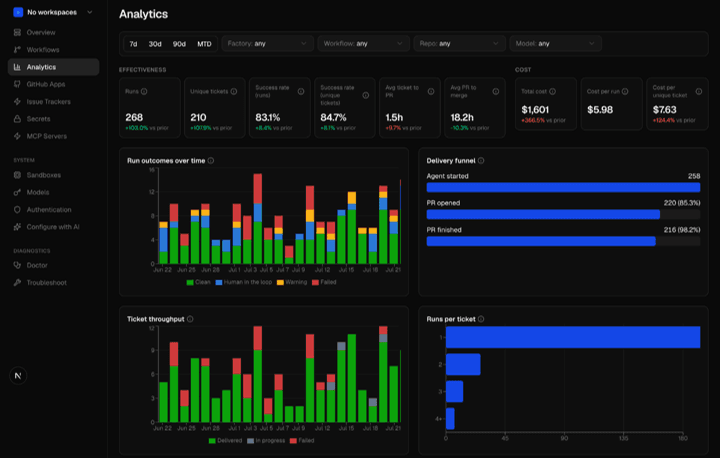
Nimble engineered a workflow that combines automated implementation with engineering oversight. 80% of work items reached merged pull requests.
- AI / Agentic Software Delivery
- of work items reach a merged pull request
- 80%
- completed without human implementation work
- 48%
- engineer-refined working pull requests
- 32%
- controlled guardrail exits to an engineer
- 13%
About Lexipol
Lexipol builds policy, training, wellness and reporting software for public safety agencies across the United States. More than 12,000 agencies and municipalities rely on its platform. Lexipol partnered with Nimble.LA to accelerate bug resolution without slowing feature development or compromising the controls required in a regulated environment.
Visit Lexipol(opens in a new tab)The Challenge
Bug resolution was slow, expensive and competed directly with feature development. Even routine tickets required a full engineering cycle of implementation, validation and review. As ticket volume grew, the team needed a way to resolve issues faster and process more work in parallel.
Nimble.LA was brought in to transform software delivery through an agentic development harness that takes routine bug fixes from requirements to completed pull requests. The first phase focused on bug resolution, establishing a foundation that will extend into feature product development.
What Nimble Delivered
- Claude-powered agentic development harness
- Coordinator agent for ticket intake and specification grounding
- Ephemeral, isolated sandbox provisioning
- Parallel sub-agent task decomposition
- Automated testing, build, deployment and security validation
- AI-assisted code review against the original ticket
- Risk-based guardrails and human escalation
Results
Nimble.LA configured and deployed an agentic harness that now runs in Lexipol’s production engineering workflow. The system executes routine development work in isolated environments, validates each change, and returns either a working pull request or a controlled escalation to an engineer.
Across every 100 tickets and user stories processed, 48 are completed without human implementation work. Another 32 produce working pull requests that engineers refine when the specification leaves a product, design or domain decision unresolved. Thirteen exit through a guardrail rather than proceed on an unsafe assumption, while seven stop because of a third-party provider or harness failure.
The model is automatically selected to match the complexity of each workflow and ticket: Opus for more demanding work and Sonnet for routine fixes, keeping operating cost aligned with ticket difficulty. Every sandbox resets to a clean baseline after execution, preserving isolation and supporting Lexipol’s SOC 2 and CJIS controls as volume scales.